








The Ceremony of Water Baptism
 .... In this posting we'll discuss a very special response to the gospel that will tie all of its implications together. It is the ‘official ceremony’ of our covenant with Jesus, the outward seal of the faith we’ve gained in our hearts, and our open declaration to the world of the same. It is the testimony of water baptism.
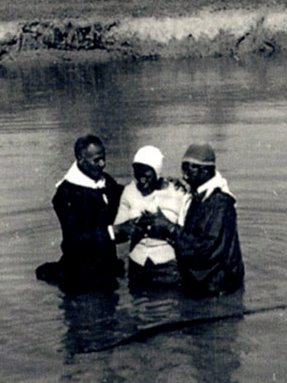
.... Water baptism represents the four points of the gospel, and it allows us to relate to them through an open, personal application. This begins with our recognition of Jesus as our Lord. Through baptism we are then lowered into the water, as into a grave, in the likeness of His death (the Greek word baptisma literally means ‘immersion’), then we are quickly raised again in the likeness of His resurrection.
.
.... The whole ceremony signifies that we have been joined with Jesus in what He has done for us, because we have believed the testimony of His witnesses. And in this we, too, will become witnesses of His resurrection:
.... "Or do you not know that as many of us as were baptized into Christ Jesus were baptized into His death? Therefore we were buried with Him through baptism into death, that just as Christ was raised from the dead by the glory of the Father, even so we also should walk in newness of life."
(Romans 6:3-4)
.... Baptismal ceremonies are performed by persons who have already believed in Jesus, who are now acting as His representative (John 4:1-2; Acts 2:38). As such they will baptize in the name of Jesus, meaning that they will baptize by His authority. But the new Christian themselves will be baptized in the name of the Father, Son, and Holy Ghost:
 .... "And Jesus came and spake unto them, saying, 'All power is given unto Me in heaven and in earth. Go ye therefore, and teach all nations, baptizing them in the name of the Father, and of the Son, and of the Holy Ghost.'"
 .
(Matthew 28:18-19)
.... Therefore, a proper baptismal statement may go something like this:
.... "By the authority of Jesus Christ, I baptize you in the name of the Father, and of the Son, and of the Holy Spirit."
To proceed to the next lesson, click here
............................................................... Daily Bible Reading: Matthew 18
posted by loren at 2:47 AM


8 Comments:
As simple as baptism may be, it is actually a controversial topic! Occasionally you may hear a debate about the authoritative statement used in baptism. Some believe it is only proper to baptize ‘in the name of the Father, Son, and Holy Ghost’, because that is how Jesus commanded us to do it (Matt 28:19). Others will note that in actual practice, the apostles baptized ‘in the name of the Lord Jesus’ and claim we should do it that way, instead (Acts 2:38; 8:16; 10:48; 19:5). But it is nonsense to suggest that the Scriptures are contradictory, and that it actually comes to a choice!
The baptismal statement given in our posting covers all of the bases. Most importantly, by following it, you will come closest to the heart of what the Lord wants to accomplish, as shown in the Scriptures.
By loren, at 5/13/2005 3:14 AM
Some have suggested that there is no actual example of anyone being baptized ‘in the name of the Father, of the Son, and of the Holy Spirit,’ in the Scriptures, and therefore we should not put it into practice either. Yet there is evidence of this very thing in Acts 19. As Paul passed through Ephesus he found some disciples and said to them,
‘"Did you receive the Holy Spirit when you believed?" So they said to him, "We have not so much as heard whether there is a Holy Spirit."
‘And he said to them, "Into what then were you baptized?" So they said, "Into John's baptism."
‘Then Paul said, "John indeed baptized with a baptism of repentance, saying to the people that they should believe on Him who would come after him, that is, on Christ Jesus."
‘When they heard this, they were baptized in the name of the Lord Jesus.’
Paul is essentially saying, ‘What do you mean you’ve never heard of the Holy Spirit? What about when you were baptized in the name of the Father, Son and Holy Spirit?’ It was then that he discovered their baptism to be invalid, and it was partly because of this omission that he had to consider it so.
By loren, at 5/13/2005 3:15 AM
In the same episode described above, Paul encountered about twelve disciples who were baptized by Apollos in his early days, before Aquila and Priscilla had explained the kingdom of God to him more fully (Acts 18:24-26). In those days Apollos only knew the baptism of John, and apparently he saw this as an end in itself, rather than a link to Jesus. I draw this conclusion because Paul had to explain who Jesus was, as well.
Because their baptism did not link them to Jesus, it was invalid, and Paul had to baptize them again to do it properly.
Sometimes you will see this passage used to claim that the whole baptism of John was invalid, but this is not the case. John the Baptist did link his baptism to Christ who would come, and so it was perfectly valid in every respect. In fact, it is the same baptism that we are baptized with today, when we are baptized in water.
To settle this easily, let us note that no person baptized by John himself was ever ‘re-baptized,’ even after the death, burial and resurrection of Christ, or the coming of the Holy Spirit.
By loren, at 5/13/2005 3:17 AM
When we are baptized in water, we are joined with Christ in His death, burial, and resurrection. The symbolism is that we are crucified with Christ, who was put to an open shame for us all. So what happens if you really blow it, and backslide? When you come back to Him, should you be re-baptized?
NO, no, no!!! For how would you put the Son of God to an open shame a second time? (Heb 6:4-6). Instead, you would need to “Stand fast in the liberty by which Christ has set you free.” (Gal 5:1).
In other words if you’ve really blown it, you would need to repent, not be re-baptized, because Christ will not be re-crucified for anyone.
Using the same example above, the only reason for a person to be re-baptized would be if something was wrong with their first baptism. For example, if they did not truly believe, then they did not truly connect with Jesus, so they would still need to be baptized as a believer (sometimes called ‘believer’s baptism’). Without that connection, a person has simply gotten wet.
Another example might be someone who was baptized at an earlier time, but in one of the cults. They could not have had a true understanding of who Jesus is or the truth of the gospel, so they could not have connected with Him. Their baptism would be invalid and would need to be done again.
By loren, at 5/13/2005 3:19 AM
Another controversy you may hear over baptism pertains to the method itself. The biblical method for baptism is through immersion in water. In fact, the Greek word literally means ‘Immersion’ and for this reason it was said that Jesus, being baptized, ‘came up from the water’ (Matt 3:16).
But some churches hold to a practice of baptism by sprinkling. The best argument behind this, is that some baptisms in the Bible took place in regions where there was not much water, certainly not enough to immerse someone (see John 3:23). Therefore it is reasoned that they must have been sprinkled.
We should be clear that the Bible never acknowledges that this is baptism, and never gives such an example. But if this method truly was the all only possibility as a matter of practicality, I do believe the Lord would look on our hearts and accept it. However, it is another matter to call this the only true method to the exclusion of immersion.
If we’re going to obey the Lord in baptism, we might as well do it right. Remember that the picture in baptism is to bury someone, and immersion adequately symbolized a lowering into the grave. Sprinkling can only be valid if it symbolizes a desire, to be truly joined with Jesus in His death and resurrection, but we just don’t have enough water. The same would be true of arguments on baptism by pouring.
By loren, at 5/13/2005 3:21 AM
Loren,
How do you think baptism fits in a community aspect ? Are we born into the kingdom of God as individuals or is there a connectedness with the whole body of Christ ?
I wonder if baptism also signifies that I have died to my individual life and now am a connected part of the body of Christ worldwide with Christ as the head. I think this is a significant point especially in modern day America where it seems our Christianity so often becomes about how "I' can grow or how "My" ministry is doing or the worship "I" prefer.
Wouldn't it be refreshing to see Christ centeredness reflected in our having a heart that focused on seeing the body function well apart from individual preference.
By Berry, at 5/13/2005 10:52 AM
Hi Berry,
I think you've really hit on an excellent point! Through baptism we are joined in a covenant with Jesus, and through Him we are also in a covenant with each other. So somewhere this must be transferred through baptism, but I will have to give this a think.
Ah! The Lord just gave me the answer!
For by one Spirit we were all baptized into one body-- whether Jews or Greeks, whether slaves or free-- and have all been made to drink into one Spirit.
(1 Cor 12:13)
and,
There is one body and one Spirit, just as you were called in one hope of your calling; one Lord, one faith, one baptism;
(Eph 4:4-5)
This is probably a little easier to see through the 'ongoing memorial' version of baptism, which is the Lord's supper. I will have an article on that on May 27.
Just one more thought. The true baptism 'of' the Holy Spirit, mentioned above, is water baptism. What we commonly refer to as 'the baptism of the Holy Spirit' is actually the baptism 'of' Jesus Christ, who baptizes 'with' or 'in' the Holy Spirit.
Far from being semantic, there is a very urgent point. The Holy Spirit is the third person of the Godhead, so to be baptized 'in' or 'with' the Holy Spirit is not primarily functional, but interpersonal with the Lord. You'll have to think about the difference this makes.
By loren, at 5/14/2005 3:19 AM
Hi Michael,
As we grow older in the Lord, we all learn a little more of what our baptism meant in the eyes of the Lord at the time. But remember that baptism was designed for new Christians, who are probably never going to have that depth of knowledge up front. This is normal, and something that God fully understands. The fact that He offers further understanding in the Scriptures anyway indicates to me that He's okay with our reaching some of that understanding later.
Unfortunately, we all sin again too, and some even the point of backsliding. In a similar way, I think 're-education', resulting in repentance, is what He would expect. Because His prespective, remember, was complete from the beginning and there has been no change in it, regardless of our own actions.
Based on what you said, I agree you should not be re-baptized. Sincere repentance is really what was needed to bring your walk with the Lord back on track. Seeing, in us, a deeper appreciation of the original baptism, is a normal thing to Him.
By loren, at 10/29/2005 11:02 AM
<< Home