





The Lord’s Supper
 .... In our last few postings we've discussed baptism which, if done correctly, need never be repeated. It is designed as a one-time event because it marks the beginning of a life-long covenant. If we do sin again, we should repent rather than being re-baptized (1 John 1:9; Galatians 5:1). But this is not to say that the meaning of our baptism is fleeting. The same understanding is constantly recalled through another ceremony called "The Lord’s Supper". This ongoing ceremony is entirely symbolic in nature, for the purpose of reminding us that Jesus died for us all:
.... "For I received from the Lord that which I also delivered to you: that the Lord Jesus on the same night in which He was betrayed took bread; and when He had given thanks, He broke it and said, ‘Take, eat; this is My body which is broken for you; do this in remembrance of Me.’ In the same manner He also took the cup after supper, saying, ‘This cup is the new covenant in My blood. This do, as often as you drink it, in remembrance of Me.’ For as often as you eat this bread and drink this cup, you proclaim the Lord’s death till He comes."
(1 Corinthians 11:23-26)
.... "But let a man examine himself, and so let him eat of the bread and drink of the cup . . . for if we would judge ourselves, we would not be judged."
(1 Cor 11:28,31)
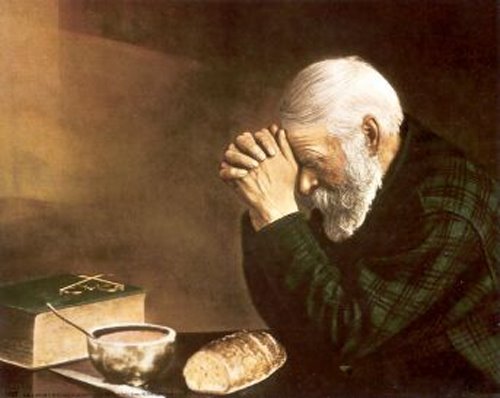 .... The Lord’s supper is a time for checking ourselves anew in our walk with God, to make sure we are still on track with Him. Like baptism, partaking of this ceremony should demonstrate, within ourselves, the answer of a good conscience toward God (1 Peter 3:21). If not, we'll need to take a moment to confess our sins and repent of them, but afterward we should still partake.
.... Here, another question presents itself. How often should the Lord’s supper be observed? There are many opinions, but perhaps the immediate context is the most correct: that it should be done simply in the context of eating a meal -- any meal -- so that it is done very frequently, as a part of our lifestyle.
To proceed to the next lesson, click here
Daily Bible Reading: Matthew 23
posted by loren at 4:07 AM


6 Comments:
How often should the Lord's supper be observed? Based on the context, one possibility is the Passover meal, which occurs annually. Another possibility is the gathering of Christians together, which probably occurs weekly or bi-weekly. Still another possibility is that it is left to the discretion of individual Churches. But the most immediate context is probably the most correct, that it is to be done in the context of eating a meal.
Think of it this way. Each of the other contexts limits our participation to a clergy-driven event, but God has made all of us kings and priests, so there is no reason to wait for that (Rev 1:6). While I don’t mean to discount the church gathering (I’ll discuss it in a moment), I believe that thankfulness begins in an individual’s own relationship with God, and that a church is simply the sum of its members. Thus, we must all seek the Lord on our own, to come together as a church that does so.
Having said that, in the first century there was a weekly ‘pot luck’ that was held in an organized way, that became know as the ‘Love Feast’ (2 Pet 2:13; Jude 12). This, too, would offer a context for the Lord’s supper. More on that in the next posting.
For myself, I have observed the Lord’s Supper at every meal since about 1982. It is very natural for me to do this, yet I always think about it sincerely and thankfully, and never get in a rote about it. This is excellent for keeping one’s heart in tune with evangelism, as well.
By loren, at 5/25/2005 4:10 AM
In many churches today, a controversial question is being considered. If a person has not yet been baptized, should they be allowed to partake of the Lord’s supper?
The reason this never came up in the New Testament is because new Christians were always baptized immediately (see the previous posting). So what we’re really asking is whether it’s alright to subsidize someone’s reluctance to be baptized, and downplay it as they have done?
I’ve thought about this for a long time. The Lord’s supper is an ongoing memorial of the covenant we confirmed with Jesus in baptism. To have this sacrament without baptism is like having an anniversary without ever having a wedding. It makes no sense.
In the Lord’s supper we are commanded: let a man examine himself, and so let him eat of the bread and drink of the cup. If a person can honestly do this, repent where necessary, and declare that they have a clean conscience, then I would take the opportunity to raise the more primary question with them: baptism is the answer of a clean conscience before God (1 Pet 3:21). Why, then, have they not been baptized?
99% of the time, when a Christian has not been baptized, I feel it is because they are ashamed of the testimony of Jesus – and the heart of our relationship with God is to honor Him. Someone may call me legalistic for saying this, but I’m talking about respect here, not just rules. I would say these persons should not partake of the Lord’s supper until they’ve honored Him properly through baptism, and while they’re at it they need to repent of the delay. Unless there’s a very good reason for that delay, I admit to being short on sympathy for them.
Most Christians would agree that it is improper for non-Christians to partake of the Lord’s supper (as a sacrament, though eating a meal together is fine). If they’ll think about their reasons for this opinion, they’ll find that they must agree with me to be perfectly consistent.
By loren, at 5/25/2005 4:10 AM
The Catholic church has a very peculiar doctrine on the Lord’s supper (which they refer to as ‘mass’). Their doctrine is called ‘transubstantiation’. Essentially, they believe that once the element of bread is placed in your mouth by a priest, it turns into the flesh of Jesus in some essential way, and you eat it. This is based on an overly literal interpretation of passages like Matt 26:26: “And as they were eating, Jesus took bread, blessed and broke it, and gave it to the disciples and said, ‘Take, eat; this is My body’."
In this particular case, Jesus is simply offering a symbol. Obviously, in doing this, His body did not dissolve itself into the bread, for His body remained present. So the bread merely represented His body. And in fact, the crux of this sacrament is not in the elements of bread and wine at all, but in the response of our heart. Jesus would explain this at length in John Chapter 6:56,63-65:
"He who eats My flesh and drinks My blood abides in Me, and I in him . . . It is the Spirit who gives life; the flesh profits nothing. The words that I speak to you are spirit, and they are life . . .He who comes to Me shall never hunger, and he who believes in Me shall never thirst.”
Transubstantiation is very problematic because it is viewed as a re-crucifixion of Christ, which was addressed in the posting itself (See also Heb 6:4-6). It is one of the great areas of contention between Catholics and Protestants.
By loren, at 5/25/2005 4:11 AM
Protestants have their own problems in interpreting the Lord’s supper. One interesting problem is the question, was there one communion cup, or two? This is based on Luke’s rendition of the event, Luke 22:17-20.
To explain this, we should understand that, in this passage, the Lord’s Supper was taking place in the context of the Jewish Passover feast. Jesus was illuminating the meaning of this feast and re-applying it to His own sacrifice as the true Lamb of God (1 Cor 5:7). Thus, it was a foreshadow of His own sufferings, as a Christian deliverance from sin, and He shows the fulfillment.
The Paschal supper actually included four, or sometimes five, cups of wine. When the first of these cups was offered, Luke 22:17, Jesus blessed it, but also announced that He would no longer drink of the fruit of the vine. Hence, the other cups were not mentioned at all. The exception was the third cup, called ‘the cup of blessing’, which is received in conjunction with the breaking of bread (these are the two elements of the Lord’s supper). To this cup Jesus attached a special significance in relation to His own sacrifice. Therefore, it is the only cup mentioned in the other gospels, and the only one with a true Christian significance.
FYI, the fifth cup was included if the great Hallel was sung, which is a series of songs from Psalm 113-118. This was undoubtedly the case in the Last Supper, for it is mentioned that their supper was closed with the singing of a hymn (Matt 26:30). And this hymn would have been Psalm 118 (read it some time - how applicable!).
By loren, at 5/25/2005 4:11 AM
Here we go again. Then I'll leave you alone for a while :)
As for partaking of Communion without being baptised, the question was settled very early in history, by the early church fathers, who explicitly denied any unbaptised person, Christian or otherwise, from participating at the table. Baptism was the entrance into the Covenant, and unless you were a member of the Covenant, you had no right to participate in the most sacred ritual of Covenant life.
And who says taking Jesus at His Word is a "hyperliteral" translation? Is it impossible for God to declare that something is His body while still being present? Was it impossible for Him to create more of the same loaf of bread so that more than 5000 people were fed? And it was precisely on that occasion, as Passover was near (John 6) that He did give the most staggeringly literal explanation and teaching of Transubstantiation. How you can read anything else into that text is beyond me.
Futhermore, in 1 Corinthians 10 and 11, St. Paul declares that anyone who eats and drinks unworthily is guilty of the Lord's body and blood. That is an Hebraic phrase saying that you are responsible for His death--in effect, you are guilty of murdering Him (cf. Ezekiel 3:17-21). How can we be guilty of murdering a symbol?
The fact that Christ makes Himself present during the sacrifice of the mass is in NO WAY a re-crucifying of Christ. Rather, in a mystical sense, we are transported to the Throne Room of Heaven, where Christ stands perpetually before the Altar as a Lamb who was Slain (Revelation 5:6), Slain, according to 13:8, since the foundation of the world! Heaven exists outside of and beyond time. What was a momentary event on earth 2000 years ago, from our perspective, is an ever-present reality to God.
In the mass, God brings us up to Him to participate for a brief moment in that ever-present reality. The Mass is not a re-sacrificing of Jesus. Rather it is a re-presentation of Christ's sacrifice to us. In a very real though mystical way, we are at once in Heaven and at Calvary. And there, we unite our sacrifices with His, applying His sacrifice to us in a new and fresh way, receiving a greater portion of His grace in our lives each time.
Passover itself gives us the reason for the relevance of this act: We all know that in order for the Israelites to be saved at Passover, they had to sprinkle the Blood of the Lamb on their doorpost. What not everyone seems to remember, though, is that God said that furthermore, the entire Lamb must be eaten for the whole Passover thing to be in effect.
Without eating the Lamb, you could pour its blood all over the door to your house, and that Angel of Death was still coming in! In the same way, Jesus, our Passover Lamb, and the fulfilment of that type, shed His blood for us on the doorpost of the Cross--but He commands that we eat the Lamb, who is Himself, in order to fully apply His sacrifice to our lives.
Since this has been the historic teaching of the Church until the time of the Reformation, who is Johnny-come-lately to say that 1500 years of Church teaching has been wrong on such a basic and fundamental issue?
By all accounts, Luther himself, as with the other reformers, seems to have been just such an authority-blaster and grabber as you mention in your end-times heresies module!
By Gregory, at 8/03/2005 4:45 PM
Hi Gregory,
I re-read the article, and I can't honestly say that I'd change anything in it. But this should not be considered a blanket endorsement of Luther. I'm much too selective for that.
However, I do want to be fair. You're completely free to disagree here, as long as you stay within the rules: to speak the truth in love, to use Scripture in your arguments, and to point us to Christ as clearly as you can.
Remember that this course is a template, and one day the comments will be gathered together for thoughtful revisions -- and maybe by persons other than me. So feel free to make your points and contributions. If you and I disagree personally, remember those future audiences and make your case with them in mind.
I have asked another friend of mine, named Dave, to review your comments and offer some comments of his own. He has more of a Catholic background than I do, so I think you'd find more common ground with him. You may see his remarks soon.
By loren, at 8/03/2005 6:27 PM
Post a Comment
<< Home