








Evangelistic Attitudes

..... In the course of evangelism, our attitude and persona can become inhibiting factors, even in ways that we may think of as being ‘good’. For example, if you have a flashy or an eloquent personality and you share the gospel that way, someone might hear you and believe – partly because of what Jesus did for them on the cross, and partly because you have so skillfully talked them into it. So is that a good thing, or a bad? Let’s consider the answer from a heavenly perspective:
.
.... In order to save us, God’s only Son was put to an open shame. The concept in His sufferings is of deepest humility. He is the senior partner in evangelism and we are the junior partners, His ambassadors, so our attitude should carefully reflect His lead (Matthew 9:38). Therefore, when our evangelism becomes mixed with personality-driven antics, it frets against God's whole purpose in presenting the cross. Put another way: when Jesus received slaps and men spit in His face, are we representing Him truly by projecting 'cooleness', dazzling with flirtatious smiles, dressing to impress, or using other forms of personal showmanship?
.... In order to save us, God’s only Son was put to an open shame. The concept in His sufferings is of deepest humility. He is the senior partner in evangelism and we are the junior partners, His ambassadors, so our attitude should carefully reflect His lead (Matthew 9:38). Therefore, when our evangelism becomes mixed with personality-driven antics, it frets against God's whole purpose in presenting the cross. Put another way: when Jesus received slaps and men spit in His face, are we representing Him truly by projecting 'cooleness', dazzling with flirtatious smiles, dressing to impress, or using other forms of personal showmanship?
.... " . . . that no flesh should glory in His presence . . . that, as it is written, 'He who glories, let him glory in the Lord.'
(1 Corinthians 1:29-31)
.... When we present the gospel in such ways, we make ourselves way too much of a factor and God will not compete with us for the glory of our hearer's salvation (1 Corinthians 1:29-31). In fact, one of the reasons He follows up on our evangelism with miracles is to quickly skip past the evangelist, and establish a direct relationship with each person (1 Corinthians 2:5). He wants us to point to Him as best we can, without inserting ourselves in between!
.
 .... Let’s use Paul as an example of this truer concept. In the natural, his bodily presence was weak and his speech was contemptible. When he spoke, some of his listeners would even mock him: ‘What does this babbler want to say?’ (2 Corinthians 10:10; Acts 17:18). Nevertheless within his mission team, Paul was the chief speaker (Acts 14:12).
 .... Let’s use Paul as an example of this truer concept. In the natural, his bodily presence was weak and his speech was contemptible. When he spoke, some of his listeners would even mock him: ‘What does this babbler want to say?’ (2 Corinthians 10:10; Acts 17:18). Nevertheless within his mission team, Paul was the chief speaker (Acts 14:12).
 .
.... Therefore, if anyone believed in Jesus through his word, it was because they listened to what he was saying, and believed in the One he was talking about. And since this was the Lord’s ultimate goal as well, He began working through Paul mightily:
.... "I was with you in weakness, in fear, and in much trembling. And my speech and my preaching were not with persuasive words of human wisdom, but in demonstration of the Spirit and of power, that your faith should not be in the wisdom of men but in the power of God."
(1 Corinthians 2:3-5)
.... So be a good junior partner and defer to the Lord in the first place, by remaining humble of spirit and by keeping a servant’s attitude, both to Him and toward man. If you won’t do this, it's true, He may still use your words to plant a seed, and He may try again to save this person in a future effort (see Philippians 1:18). But on the other hand if you are really unwilling to bend, you'll find God working in this area of your life to enforce a little more humility in the future -- and beyond any contradiction, you would not find this pleasant (1 Corinthians 1:29-31; Hebrews 12:11).
.
 .... So remember that in Christ the Lord, we must always decrease and He must increase; and those who exalt themselves will be humbled, but those who humble themselves will be exalted in due time (John 3:30; 1 Peter 5:6).
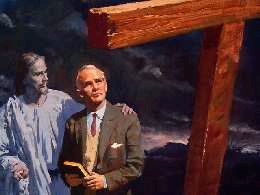 .... So remember that in Christ the Lord, we must always decrease and He must increase; and those who exalt themselves will be humbled, but those who humble themselves will be exalted in due time (John 3:30; 1 Peter 5:6).
.... "Those who are wise shall shine like the brightness of the firmament, and those who turn many to righteousness like the stars forever and ever."
(Daniel 12:3)
To proceed to the next lesson, click here
Daily Bible Reading: Mark 15
posted by loren at 2:40 AM


2 Comments:
One evening I tuned into a Christian TV station. A muscle bound evangelist in a close fitting shirt was moving across the stage in power moves. He jabbered jingles and tossed out platitudes in preacher-speak (that annoying jargon in which God is pronounced ‘Gawd’).
The camera panned to the audience where a young man was bopping up and down in place as if to say “I’m excited! I’m excited!”
In my opinion, he was the only person making an even bigger idiot out of himself.
“. . . be an example to the believers in word, in conduct, in love, in spirit, in faith, in purity.”
(1 Tim 4:12)
In disgust, I pressed the remote to turn it off – but I must have hit the wrong button, because it only turned off the sound. In quiet amazement, I watched those soundless antics for a moment longer, then shook my head. Then I changed the channels.
I guess I thought the sound would automatically return when I did that, but it didn’t. Now I saw a well dressed young man with a pleasant smile, obviously addressing an audience. He occasionally made warm gestures toward them and smiled again. It made me very curious about what this could be. So I turned on the sound to see. It was a comedian!
I turned off the sound again, and switched back to the first station. Now the evangelist was practically turning back flips, and the same young man was bopping up and down and really losing it. I switched between those stations a few more times, in silence. “I would think that the preacher is the comedian.” I concluded, “and that the comedian was the preacher!”
Using the criteria described in the main posting, how much of a help is this sort of behavior, and how much of a hindrance? Is he using his ministry to promote the kingdom of God, or is it the other way around?
By loren, at 6/28/2005 3:08 AM
One more thought. Have you ever heard a Christian talking to a someone else about the Lord? Often, they’ll begin by talking like a normal person, but when they come to quoting Scripture their manner will change. They’ll pause to ‘primp’ the Scripture, like quoting poetry, and share it that way.
To me, this always had the appearance of drifting out of the ‘real’ world, where people actually live, and momentarily drifting into the ethereal world which may (just possibly) have some bearing on the real stuff we’ve been talking about.
In other words, to me this practice offers the appearance of mindless adherence, and it seems to diminish the concept that the Scriptures are practical in this life. But if we would just work the scriptural quotation into our normal conversation, in a normal tone of voice, (whether we quote it verbatim or paraphrase it,) I think it has a lot more impact and it would present the picture that you live what you believe.
I urge you to consider this, bearing in mind that we are to ‘be an example to others in our word and conduct’ (1 Tim 4:12, quoted above).
By loren, at 6/28/2005 3:08 AM
Post a Comment
<< Home