







The Corinthian Disorder
 ..... Paul's letters to the churches, called epistles, were weighty and powerful, and he seemed to have a flare with his opening remarks (‘Grace to you and peace’, etc.). To many of us, this may have seemed like flowery speech and nothing more, but he wasn't trying to be flamboyant. There was always a carefully chosen point behind those words. Paul was setting forth the basic position he intended to speak from throughout the rest of the epistle. This basis was called his premise, and Paul’s premise in 1 Corinthians was that Jesus Christ is the author and the finisher of our faith (1 Corinthians 1:1-9).
 ..
.... Now, why would Paul need to emphasize Jesus to the church at Corinth? They’re Christians aren’t they? Yes, they’re like many of the Christians we know today. (They're zealous for spiritual gifts, for example--1 Corinthians 14:12). But they are Christians with a problem. And their problem is that they are starting to draw away from the knowledge of Jesus, and to leave Jesus out of their Christianity.
.... Now, why would Paul need to emphasize Jesus to the church at Corinth? They’re Christians aren’t they? Yes, they’re like many of the Christians we know today. (They're zealous for spiritual gifts, for example--1 Corinthians 14:12). But they are Christians with a problem. And their problem is that they are starting to draw away from the knowledge of Jesus, and to leave Jesus out of their Christianity.
.
.... Now, it is true that the Corinthians were still learning things, but they were no longer seeing Jesus in the things they learned. So even though they thought they were getting ahead, they were actually degressing in their walk with Him. We find the same concept at the junction of Hebrews chapters 5 and 6:
.... Now, it is true that the Corinthians were still learning things, but they were no longer seeing Jesus in the things they learned. So even though they thought they were getting ahead, they were actually degressing in their walk with Him. We find the same concept at the junction of Hebrews chapters 5 and 6:
.... " . . You have become dull of hearing. For though by this time you ought to be teachers, you need someone to teach you again the first principles of the oracles of God; and you have come to need milk and not solid food"
(Hebrews 5:11-12)
.... For all of their learning, these Corinthians needed someone to teach them again ‘the elementary principles of Christ’ (Hebrews 6:1); because a fundamental departure had already taken place, and they were leaving Him out of their beliefs more and more.
..
 .... The reason this happened was because their focus had shifted to men, to the preachers themselves, instead of focusing on Jesus; and of course, this was completely unintended by the preachers (2 Corinthians 4:5). In fact, if we follow the whole train of thought (1 Corinthians 1:1-9), Paul is reminding the Corinthians that Jesus is the author and finisher of their faith because they’ve now begun squabbling in terms of "I am of Paul," or "I am of Apollos," or "I am of Cephas." (v 10).
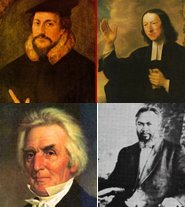 .... The reason this happened was because their focus had shifted to men, to the preachers themselves, instead of focusing on Jesus; and of course, this was completely unintended by the preachers (2 Corinthians 4:5). In fact, if we follow the whole train of thought (1 Corinthians 1:1-9), Paul is reminding the Corinthians that Jesus is the author and finisher of their faith because they’ve now begun squabbling in terms of "I am of Paul," or "I am of Apollos," or "I am of Cephas." (v 10).
.... "Is Christ divided? Was Paul crucified for you? Or were you baptized in the name of Paul?"
(1 Corinthians 1:12-13)
.... It isn't about man, it's about the Lord! But with the ascension of man in their esteem, the Lord Himself took more and more of a back seat until, in their own minds, He had actually begun to fade into the past. 'Church' was about the preachers and their personalities now, and the ‘ministry machine’ that was perceived through them.
.
.... How different than that are we, today? We'll continue this discussion in our next posting; but between now and then please think of what consequences this would bring, and how our living relationship with Jesus might suffer as a result.
To proceed to the next lesson, click here
Daily Bible Reading: Luke 20
posted by loren at 11:59 PM


17 Comments:
The modern mind seems to prefer systems and arrangements to the heavenly relationship, so unfortunately this is something that we have in common with the Corinthians. We’ll discuss this more specifically in a future posting.
By loren, at 7/27/2005 12:02 AM
How many times have you gone past a church building, and seen their sign out front with the name of the church? Underneath, in nice big letters it says ‘JOHN DOE -- SENIOR PASTOR’ or something similar. I think this shows that we’ve bought into the Corinthian perspective.
I am waiting for the sign that says, in the same big letters: ‘JESUS CHRIST – SENIOR PASTOR’ and maybe underneath it in some smaller letter and parenthesis: ‘(John Doe, Associate Pastor)’.
By loren, at 7/27/2005 12:02 AM
Funny, how our human bent is to make men and women our hero's. How many times do we see a person that has been gifted by God for a certain purpose or with a specific authority and we want to make them people without fault. But it's not possible, they are human and do have faults.
Not only are we bent to make hero's of others, we also pursue being hero's ourselves. It is an overwhelming task to become a Christian hero because it can't be done.
Paul understood this and redirected the Corinthians to the one and only true hero, Jesus Christ. All the giftings and authority He releases to His people is not about them taking glory, but about them becoming humble servants who love to please Him.
By Berry, at 7/27/2005 1:33 AM
Hey Loren,
Glad to see you traveling the net and dialoguing with a variety of people. I wonder what God will do with all of this. I saw your e-mail about Thomas Nelson, that is great news.
By Berry, at 7/27/2005 1:35 AM
Too often churches become personality cults, like you say. So much time is spent engineering sermons to be the most effective (read: entertaining) that the message gets lost in the glamour. The preacher, sadly, is too often judged by his delivery more than by his content.
Our cultural milieu doesn't help much, either. Everything is new, fast and exciting, and anything that isn't is boring and obsolete! From what we know about Corinthian culture, I'd say that it had a large role in the Corinthian Christians' behaviour.
When a church takes Jesus off the altar, it's the inevitable conclusion. We stop being counter-cultural, and just start being cultural.
Anyway, thanks for stopping by, Loren. Thought I'd return the favour.
God bless!
By Anonymous, at 7/27/2005 5:22 PM
Yeah, we need to leave Oz and discover Yeshua.
By Bhedr, at 7/27/2005 8:49 PM
Loren,
Concerning Sufferings and Glory:
I got thru half of it. You have done your work bro. It looks like Jesus means the world to you. Wow we all need to take a look through the lens of the prophecies fulfiled in the O.T. You have provided a valuable resource.I think I will use it for the kids at Family Altar. Bless you brother!
It's gonna take some time to really study this. I hope more bloggers check it out
8:59 PM
By Bhedr, at 7/27/2005 8:52 PM
Do you have the OT prophecies on this site? I found a list of 315 online, that I edited (there were some mistakes--for example, they had titled it "324 Prophecies". I was wondering if you had a similar (or same) list.
I need to do some research and update it, though, because it was accumulated by a Protestant (not that there's anything wrong with that ;) ), but as a Catholic, I have discerned clear Messianic prophecies in the Deutero-Canonical books as well.
I don't suppose anyone else would have a list including those 7 books...?
Brian, I definitely think you're on the right track with "tak[ing] a look through the lens of OT prophecy". I think it goes further than texts that are specifically prophetic, though. As St. Augustine pointed out, "The New Testament is concealed in the Old, and the Old is revealed in the New." It's not just OT Prophecy that we should be concerned with, but the whole OT--because it's one singular unit!
Everything in the Bible points to Jesus. A great book that I read on that was "A Father Who Keeps His Promises" by Dr. Scott Hahn. It looks at the OT Covenants and shows how the New Covenant in Jesus is a continuation and a perfection of those covenants! Really great and insightful book.
God bless!
By Anonymous, at 7/28/2005 12:49 AM
Hi Gregory,
In the left hand column of my home page, you'll see a break-out module entitled 'The Sufferings and the Glory'. This tells the entire passion narrative, from Gethsemane to the ascension, through Jesus' own perspective (as explained through the Messianic prophecy). I'd be very interested in your thoughts.
By loren, at 7/28/2005 1:27 AM
I read that module, and it was powerful. The way you strung together the different prophetic texts was well done. It was like reading the Gospel again for the first time :D
I am always moved when someone or something opens up Scripture to me in a new way, whether it's through a close examination of prophecies, or when I learned about the principles of typology for the first time--it makes me tear up, honestly.
Dr. Scott Hahn, whom I mentioned, remarks in his book, "A Father Who Keeps His Promises", that God writes history the way men write novels. Every detail, even seemingly insignificant ones, is important.
It is so important to keep our glory in the Cross. Here it is that our sins were forgiven. Here is where Jesus was triumphant! Growing up in my old church, Good Friday was too often looked at as "hurry-up-let's-get-to-Sunday!" Obviously, as St. Paul writes, if it weren't for Easter Sunday, "we would be of all men most to be pitied." But it is that same St. Paul who tells us, as you repeated here, "I determined to know nothing among you except Jesus Christ, and Him crucified!" We need to know Jesus here, as St. Paul strove to, in order to really grasp the glory of the Resurrection.
If we fail to see the Glory of the Cross, then we miss it. St. John's Gospel, if you notice, never portrays Jesus as suffering, even during His Passion. John knew that this was the thing, this was where Jesus was glorified! "'And when I am lifted up from the earth, I will draw all people to Myself.' By these words He indicated the kind of death He would die" (John 12:32-33).
That was why I so deeply appreciated Mel Gibson's "The Passion of the Christ." He really seemed to get it (and the OT prophetic types, like the Snake in the Garden, were a fantastic touch!). I talked to people who were disappointed that the Resurrection wasn't focussed on more, but it was included--and more, the point was to draw us into the Passion, and make us realise our own part to play.
Getting back to the module, I wanted to quote one of the clearest OT prophecies of Jesus death, and His Divine Sonship, that was explicitly fulfilled in the New Testament as the Pharisees and the Crowds mocked Jesus as He hung on the Cross.
The OT passage is Wisdom 2:12-20 (Deutero-Canonical, or "Apocrypha"):
"12 'Let us lay up traps for the upright man, since he annoys us
And opposes our way of life,
Reproaches us for our sins against the Law,
And accuses us of sins against our upbringing.
13 He claims to have knowledge of God,
And calls himself a child of the Lord.
14 We see him as a reproof to our way of thinking,
The very sight of him weighs our spirits down;
15 For his kind of life is not like other people's,
And his ways are quite different.
16 In his opinion we are counterfeit;
He avoids our ways as he would filth;
He proclaims the final end of the upright as blessed
And boasts of having God for his father.
17 Let us see if what he says is true, and test him to see what sort of end he will have.
18 For if the upright man is God's son, God will help him
And rescue him from the clutches of his enemies.
19 Let us test him with cruelty and with torture,
And thus explore this gentleness of his
And put his patience to the test.
20 Let us condemn him to a shameful death
Since God will rescue him--or so he claims.'"
Sounds like Jesus' entire dealings with the Pharisees! (The Beatitudes are even alluded to!)
New Testament fulfilment--Matthew 27:39-44:
"39 The passers-by jeered at Him; they shook their heads 40 and said, 'So You would destroy the Temple and in three days rebuild it! Then save Yourself if You are God's Son and come down from the cross!' 41 The chief priests with the scribes and the elders mocked Him in the same way, 42 with the words, 'He saved others; He cannot save Himself. He is the king of Israel; let Him come down from the cross now, and we will believe in Him. 43 He has put His trust in God; now let God rescue Him if He wants Him. For He did say, "I am God's Son."' 44 Even the bandits who were crucified with Him taunted Him in the same way."
Sometimes I wonder what the Chief Priests were thinking--or if they were just reading that passage!
Those are my woefully incomplete thoughts at this time. If you're interested, in the February and March archives on my blog, there's a series on Gibson's "The Passion of the Christ" that I did with the Youth Group. It even has time indexes if you've got the DVD!
God bless! Sorry this reply was so long!
By Anonymous, at 7/28/2005 4:18 PM
No problem with long comments, they are for posterity. Glad you like the Sufferings and the Glory module.
I've looked at some of the apocrypha before (not all of it) and some of it is very, very impressive, but to my mind, still rejected right because of doctrinal flaws. For instance, the Wisdom of Jesus the Son of Sirach is amazing, virtually another Solomon, and I dropped my jaw when I read it. But in a few places he went astray into Pantheism, which of course touches on the person of God and sent up red flags for me. But maybe we can discuss this further on another day.
By loren, at 7/28/2005 4:48 PM
Sure. The Apocryphal books are still relatively new to me (I've only been a Catholic for a year and a half), but I'm not sure where Sirach necessarily drifts into pantheism.
And if that's your criteria, Ecclesiastes drifts into Existentialism, which touches on despair, the opposite of the Cardinal Virtue of Hope. Should that have been rightly rejected as well, then?
But I'd love to discuss it sometime! God bless!
By Anonymous, at 7/28/2005 6:11 PM
I guess we could go around on this. Ecclesiastes is about the despair of a life without God, which is simply the other side of the coin from the hope we have in Him. Besides, I'm a gloomy guy so I like Ecclesiastes.
Here's the thing though. If the church is ever going to fulfill it's destiny it must be willing, in principle, to bring everything to the table for another look. And if any sort of change is needed, only one principle can command it: that the suggested change would show us Jesus more clearly than we have seen Him before, and bring us all a little closer to Him as a result. And the same thing would happen to bring us closer to each other (all of this comes from Eph 4:13).
Say Gregory, one of these days you'll have to tell about the conversion. That's interesting.
By loren, at 7/28/2005 9:34 PM
It's at "Grace for the Wayward Heart", the post titled, "Stand up and Testify".
By Anonymous, at 7/29/2005 2:38 PM
Hi Gregory,
Sorry I didn't have a chance to respond yesterday, I'm playing catch up today, then I'll read over your testimony. This should be interesting.
By loren, at 7/30/2005 1:32 PM
Here's the thing though. If the church is ever going to fulfill it's destiny it must be willing, in principle, to bring everything to the table for another look.
I'm not entirely sure what you mean by this. What, in principle, is "everything" that needs to be brought back to the table? "Everything" is a pretty big word. Should the Church "reexamine" such things as the Divinity of Christ? The Trinitarian nature of God? As Christians, we believe certain things are de fide truths, unchanging and known (even if they're mysterious and not fully understood) because God has guided His Church to the knowledge of these truths.
And if any sort of change is needed, only one principle can command it: that the suggested change would show us Jesus more clearly than we have seen Him before, and bring us all a little closer to Him as a result.
That's a good principle in theory--but sometimes, it has amounted to reinventing the wheel. Another good principle is "If it ain't broke, don't fix it." By that I mean, there's a lot in 2000 years of Christian Tradition that had needlessly been thrown away that had been the tried and true method of teaching the faith and bringing people to a better understanding of Christ.
And the same thing would happen to bring us closer to each other (all of this comes from Eph 4:13)."
Ultimately the question comes down to, in the case of the Apocrypha and beyond, who decides what is part of Scripture. It's one thing to read a book of the Bible and believe this is God's inspired Word, I should believe it. It's another thing to say about the Scripture that has been handed down to us as God's inspired Word, "I don't necessarily agree with that part. I don't think it really is Scripture." This, putting it mildly, was Luther's attitude, and it didn't end with the so-called "Apocrypha", but, if he'd had his way, would have included the Epistle of James and the Revelation.
Sorry to ramble. If there's a more appropriate venue to discuss this, let me know. We could do it on either of my blogs, if you prefer. Lemme know!
God bless.
Gregory
By Anonymous, at 7/30/2005 9:59 PM
Hi Gregory,
Sorry, I didn't mean to be confusing. Let me back up a minute and explain my premise, and then maybe my remarks will make more sense.
I believe the Bible foretells a reformation that will occur in the church of the end times. There is a whole break-out module devoted to this, and that's where I would suggest we carry on our conversation. That way we can discuss each facet separately. But here's the short version:
In the end times, the true church will begin to re-examine the Scriptures through a 'hermeneutic', called 'the knowledge of the Son of God.' (Eph 4:13). They will do a better job in finding Jesus in their beliefs than any generation before them, including, in many way, the first century church:
http://pold.blogspot.com/2005/03/end-time-reformation.html
Through this emphasis on Jesus, they will eventually reach a new unity of the faith (same vs). In other words, doctrinal changes are foretold as the end draws near. So how would this effect all the churches of today?
As an example. You're Catholic, and no doubt loyal to the Catholic doctrines; here's a Calvinist with the same fierce loyalty to his own doctrines; Orthodox churches have their own doctrines which they are loyal to. Yet these groups have different teachings on the very same subjects. Are there different versions of the truth? They could all be wrong, but they could not all be right; or at least their beliefs are explained inadequately.
Now what would induce a Catholic, a Calvinist, and Orthodox (and for that matter everyone else,) to even give their own doctrines another look? (Because they're never going to reach agreement unless they're willing to honestly do that.) Each is already loyal to the doctrine of his church! Yet every true Christian has a higher loyalty than his church: his loyalty to Jesus Himself, who saved his very soul. (Now, if anyone tells me they don't agree with that, at least in principle, I'm going to tell them that they're not really a Christian.)
Let's say, for example, that we discussed a subject. Just to pick an example, let's choose water baptism. Let's say that an honest and fresh look at this subject yielded a new perspective of Jesus that we had simply never seen before. It's testimony of Jesus just opened our eyes in some way, and helped us connect with Him. At that point, the Catholic, Calvinist, the Orthodox,and everyone else would be faced with a choice. Either to accept this truth and draw nearer to Jesus, or else to hold fast to their own doctrine, which was not necessarily Christ centered. But at that point, this would mean denying something they've seen of Jesus in order to do so. I argue that no true Christian would ever do that. Even if it was hard, he would follow the Lord where ever it took him.
The prophecy I mentioned will come true in it's time. One day, hopefully soon, a renewed focus on Jesus will begin to challenge our beliefs in a good, healthy way. For this, churches must not find it 'unthinkable' to discuss their present doctrines. If they think those doctrines are correct, they may surely make the case for it, andmaybe convince the others. But it has been my experience that churches are the most dogmatic about their weakest doctrnal arguments: 'My wheel ain't broke; the other hundred churches have broken wheels. I'm not even going to discuss this.' is really ducking the issue; and that's never going to get us anywhere. Meanwhile, doctrines like the ones you've mention find pretty universal agreement, so I don't think anyone would even ask to look at them again.
Anyway, I too am rambling now. I would love discuss this further, but for now I must get some sleep (it's almost 1 a.m.).
By loren, at 7/31/2005 2:40 AM
Post a Comment
<< Home