





Effective Personal Testimonies

.... "But sanctify the Lord God in your hearts, and always be ready to give a defense to everyone who asks you a reason for the hope that is in you, with meekness and fear."
(1 Peter 3:15)
 .... In a similar way, if you’re sharing the gospel and someone says to you, "Oh yeah? Then what good has the Lord ever done for you?" -- your relationship with Him has been called in question, so you must give a defense for the hope that dwells within you. The time for sharing your personal testimony has properly come, but even so you should allow your story to form the background for a true gospel presentation (see Acts 26:1-23).
 .... ". . . and then I finally heard the message I needed to hear: that Jesus is the Son of God, and He died for our sins as the prophets foretold of Him; that He rose from the dead on the third day, and that this, too, was foretold by the prophets. And after His resurrection He was seen by many witnesses. And that gave me a lot to think and pray about, as I tried to apply it to myself . . ."
.... "And they overcame him by the blood of the Lamb and by the word of their testimony, and they did not love their lives to the death."
(Revelation 12:11)
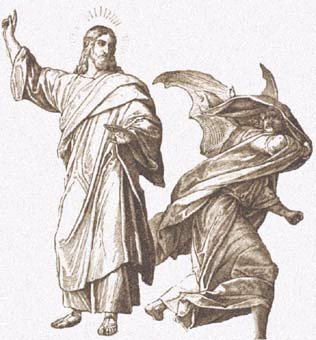 .... According to this passage, we overcome the accuser (the devil,) through the word of our testimony. But in this particular sense, it is not talking about the story behind our conversion! But rather, it is the profession of our faith in the Lord, which is the effective point of our conversion: "I have believed that Jesus Christ is the Son of God, and by believing I have life in His name." In fact we may see this testimony, and an example of how it overcomes the wicked one, in the passage below:
.... 'He said to them, "But who do you say that I am?" Simon Peter answered and said, "You are the Christ, the Son of the living God." Jesus answered and said to him, "Blessed are you, Simon Bar-Jonah, for flesh and blood has not revealed this to you, but My Father who is in heaven. And I also say to you that you are Peter, and on this rock I will build My church, and the gates of Hades shall not prevail against it."
(Matthew 16:15-18)
To proceed to the next lesson, click here
Daily Bible Reading: Luke 14
posted by loren at 12:29 AM


0 Comments:
Post a Comment
<< Home