


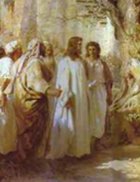





Authority Teachings

.... Even while Jesus walked with the apostles, the same issue had surfaced secretly and repeatedly in their hearts. They knew that Jesus would be gone one day, so they constantly argued about which of them would be the greatness (Luke 9:46; Mark 10:37; Luke 22:24). But Jesus overheard them and answered their ambitions by saying:
.... "You know that the rulers of the Gentiles lord it over them, and those who are great exercise authority over them. Yet it shall not be so among you . . ."
(Matthew 20:25-26)
 .... Jesus would grant authority of that nature to no one, for He alone is the head over all things to the church (Ephesians 1:22). Yet many Christian leaders today, even in Protestant churches, believe they have received an actual authority over other believers.
  Their arguments are rather heavy-handed to say the least. In fact, they are often prefaced with subtle accusations of rebellion for anyone who would dare to disagree with them (comparing them to Cain, for example); and if anyone would even keep an open mind on the subject, they are belittled in advance as ‘deceived’, acting ‘contemptuously’, being motivated by ‘self will’, perhaps even ‘betraying a complete loss of the fear of God’.
.
 .... In a recent book on this subject, the author misapplied 1 Samuel 10:25 by recalling that "Samuel explained to the people the behavior of royalty and wrote it in a book." He then stated that his goal in writing his own book was similar, meaning that he intended to explain the scope of authority that God had delegated to Christian ministers. But in that passage, Samuel was actually warning the people about royalty because it was a form of rejecting God’s own authority:
 .... "And the LORD said to Samuel, "Heed the voice of the people in all that they say to you; for they have not rejected you, but they have rejected Me, that I should not reign over them . . . however, you shall solemnly forewarn them, and show them the behavior of the king who will reign over them."
(1 Samuel 8:7-9)
.... "You were bought at a price; do not become slaves of men."
(1 Corinthians 7:23)
.
 .... But in reality, this argument merely assumes what it really need to prove. In other words, it must first be shown that such an authority was given to those ministers, and only then could that verse could be rightly applied to them. On the contrary, that passage speaks of secular authorities such as governments, employers, teachers and even parents, and we have already established that Jesus made a vital distinction in that regard. He plainly stated that church leadership was not to operate in such ways, but rather, that they should become servants, just as He Himself had come as a servant to God and to men (see Matthew 20:25-26, quoted above).
 .... "And even now the ax is laid to the root of the trees. Therefore every tree which does not bear good fruit is cut down and thrown into the fire."
(Matthew 3:10)
 .... By going to the premise of this argument in this way, we are laying the ax to the root of the trees and their argument is entirely defeated, for it is impossible to draw a true conclusion from a faulty premise. Nevertheless, for purposes of our own information, in our next postings we’ll examine their beliefs further in order to show that their position, even if it did have a premise, would still be abusive.
To proceed to the next lesson, click here
Daily Bible Reading: 1 Thessalonians 2
posted by Cleopas at 12:59 AM


1 Comments:
Most of the points made in this posting are in response to the book Under Cover, by John Bevere, which will also serve as the ‘opponent model’ in the rest of this series.
By Cleopas, at 1/19/2006 1:01 AM
Post a Comment
<< Home