


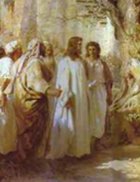





The Laborers in the Vineyard

.... Throughout history and the scriptures many of those servants, such as Moses, served with absolute devotion and faithfulness in the Lord’s house (Hebrews 3:5). But over time, a subtle corruption occured in the hearts of others, and would begin to fester. "The master has been gone for a long time" they began to think, and they turned covetous eyes upon the master's property to claim it for their own. And, as often as they did happen to hear from the master, they began to rebuff Him:
.... "Hear another parable: There was a certain landowner who planted a vineyard and set a hedge around it, dug a winepress in it and built a tower. And he leased it to vinedressers and went into a far country. Now when vintage-time drew near, he sent his servants to the vinedressers, that they might receive its fruit. And the vinedressers took his servants, beat one, killed one, and stoned another. Again he sent other servants, more than the first, and they did likewise to them. Then last of all he sent his son to them, saying, 'They will respect my son.' But when the vinedressers saw the son, they said among themselves, 'This is the heir. Come, let us kill him and seize his inheritance.'
(Matthew 21:33-38)
 .... It was evident to everyone who heard this parable that Jesus was talking about the chief priests, Pharisees and scribes (Matthew 21:45; Luke 20:19). They had labored in the Lord's vineyard for so long that they felt they had come to own it by now, and that it was all about them; it was about the 'ministry machine', and they wanted to be the ones who controlled it. So of course, Jesus was someone they would want to resist, push out of the picture and eventually kill.
 .... After the ascension of Jesus, this cycle would begin again within the church itself. Most of those who followed Him in the beginning were entirely sincere, and labored in His vineyard faithfully. But over time, the same covetous desire would fester in the hearts of some other Christian leaders. Their attitude changed as they sought to establish themselves through the church; it was all about them and the new ministry machine. And in each generation that has followed, within this segment of the church, new leaders would arise who would learn their ways and become even worse than the ones who were before them:
.... "They have a heart trained in covetous practices, and are accursed children. They have forsaken the right way and gone astray, following the way of Balaam the son of Beor, who loved the wages of unrighteousness . . ."
(2 Peter 2:14-15)
.... "But evil men and impostors will grow worse and worse, deceiving and being deceived."
(2 Timothy 3:13)
 ....Especially, many churches would develop their own traditions on ‘authority’ at the expense of the true authority of Jesus Himself (Mark 7:13). When presenting themselves in this way, these Christian leaders impose themselves as mediators between ourselves and the Lord, which intrudes into the very Lordship of Christ. And thus they may cause a separation between us and Him:
.... "For there is one God and one Mediator between God and men, the Man Christ Jesus."
(1 Timothy 2:5)
 .... Any person familiar with the Catholic leadership model will recognize the application of these remarks, yet the Catholics are by no means alone in this. In many segments of the Protestant church itself, another tradition on authority has evolved and is gaining acceptance – and it is very close to the historic Catholic model. For it envisions the authority of Christian leaders over individual Christians and requires their unquestioned obedience . . . even to the point of issuing thinly veiled threats to achieve this end.
 .
.To proceed to the next lesson, click here
Daily Bible Reading: 1 Thessalonians 1
posted by Cleopas at 12:32 AM


2 Comments:
Mediators appears in many forms. Some intend to usurp the Lord’s authority outrightly, as might be found in the case of false teachers. Others, though still acting erroneously, at least have better intentions. Unscriptural teachings such as ‘shepherding’, ‘accountability’, and ‘the covering of the church’ might fall into this category (1 Tim 2:5). Yet each of those concepts bolsters the role of leadership by intruding on the individual’s walk of faith:
“Not that we have dominion over your faith, but are fellow workers for your joy; for faith you stand.”
(2 Cor 1:24)
The issue of mediators and the issue of authority are often intertwined. ‘Authority’ has been a major subject of discussion in the church for 500 years, since the days of the Protestant Reformation. All differences between the Catholic and Protestant churches, for example, may ultimately be traced to this single issue.
By Cleopas, at 1/17/2006 9:33 PM
In early 1998, I heard the story of a Russian Orthodox priest who was complaining about the Protestant missionaries in his country. He felt that he had previously been "the master in his own house", and who did these upstarts think they were?
Sorry comrade, but YOU were never the master in the house! And maybe you could learn something from these other servants who were still willing to serve their Lord out of love for Him!
Anyway, I thought this was a good, modern example of this mindset. He seemed to think the 'ministry machine' was all about himself, now.
By Cleopas, at 1/17/2006 9:37 PM
Post a Comment
<< Home